
The Iron Butt Rally is long distance motorcycling's most challenging endurance event. It runs once every two years in the continental US and Lobo Loco Rally Master, Wolfe Bonham, is a veteran of the event. Wolfe ran the 2023 IBR and has been sharing his ride on Facebook, but he said he's OK with guest posting on TMD, so here is parts 4-6! Eleven thousand miles in eleven days? Enjoy!
Parts 1-3 can be found here.
Part Four - IBR 2023
The Heavens Open up
Heading southbound it isn't long before I encounter my first of many mechanical issues. I notice my windscreen is getting closer and closer to my cell phone. I had adjusted it yesterday and it becomes apparent I didn't torque down my Tobinator tight enough. I jump off at the next exit and waste 10 minutes getting it done right. This will be one of many roadside repairs in my near future.
Back on I-79 and it's not long before I realize I'm running short on fuel much sooner than expected. I check my Garmin for the next available fuel and am once again off the highway. My auxiliary fuel cell is transferring fuel much slower than anticipated and I make a mental note to turn the transfer valve on sooner. On the upside this exit has a Jersey Mike's, so I quickly snag a Bingo location while off the highway with a quick iced tea.
 My next fuel stop snags the ever present Waffle House chain, but then I see the storms building across my path. The next 2 days will have me ride through no less than 7 severe thunderstorms.
Crossing on HWY 19 the weather changes. What had been a rather warm afternoon suddenly becomes very cold, and the skies open up.
Prior to the rally I had discovered that my now 6 year old Klim Carlsbad riding suit was no longer shedding water like it used. I had followed their instructions to re-water proof the outfit, but this would be the first real test.
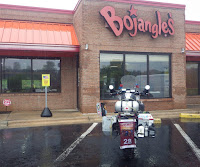
Eventually the rain was becoming so heavy that my wheels were parting puddles deep enough to send spray up to my knees. Worried about hydroplaning I spied an upcoming Bojangles on the next exit. That's when I also noticed I had an oil pressure light glaring at me on the dash.
It looked like a brief break would allow this storm to pass. I could get an actual meal, dry my gear, and look into my oil situation.

Soldiering on I was getting really tight on time to make The Varsity restaurant in Atlanta, GA before they closed at 9pm. This chain is on the bingo card, but only available in the Atlanta area. I figured this would likely be my only trip through Atlanta on the rally, so I had to get it today.
 This would mean passing up on visiting a Pal's Sudden Service bingo restaurant en route. I figured I'd be able to find one later in the Rally as they are more common.... spoiler alert... I didn't, and it would cost me blacking out the entire card! Day 1 decisions can have a cascading effect, like the butterfly that flapped its wings in Central America 3 days ago that is now causing the storms in the southern USA I'm now riding through.
My route to Atlanta only diverged enough to snag the high point value giant peach water tower in Gaffney, SC that was featured on the rally poster.
I called ahead to The Varsity to make sure they didn't have any ideas of closing early, threw away another planned stop at a Whataburger location, hauled ass to downtown Atlanta where Cherrelle was waiting to close with my peach lemonade already poured! Phew... and it was refreshing too.
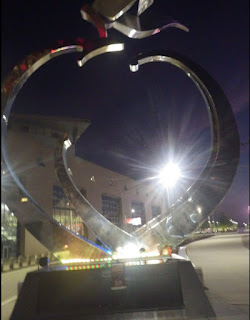
Also in the downtown was a metal peach sculpture that proved tricky to find a spot to park to take the photo. After doing a couple of laps around the nearby stadium I figured using one of the hotel lots was the only real option... and low and behold, I run into Jeffrey Gebler pulling out of one. He let's me know he had greased the valet with a few dollars to let him park there. I quickly followed suit.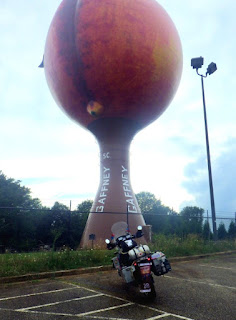 On returning to my bike a group of high school students and their teacher were checking out my bike. They were in town on a skills competition for, of all things, motorcycle and small engine repair. I took a few moments to chat with them and show them the live tracking. We wished each other good luck in our competitions and I headed out of Atlanta for Florida.
This final stretch of the night had me in more thunderstorms and it was becoming quite obvious that my Klim gear was indeed no longer waterproof. More concerning was the amount of water now pooling in my Sidi Adventure Goretex boots from running down the back of my calves.
Watching the tracker I knew most Florida bound riders had pulled off for the night, and I could see they were snug out of the weather in hotels along I-75S.
I was determined to push further and arrived at the Florida welcome center rest area where I curled up on a picnic table under an awning for 2 hours sleep...
Or so I thought...
Part Five - IBR 2023
The Struggle is Real

I make my way through several clusters of storms on the way to Cedar Key in the dark. It should be just after sunrise when I arrive.
Suddenly my lights pick up movement from the ditch. An armadillo is attempting to cross the road, and given the wet conditions there's very little I can do but brace for impact. I've always feared hitting one of these after seeing one destroy a wheel well and fender of an RV as a child. I expect it to be like hitting a rolling bowling ball. Bam!
In actual fact it was more like a large raccoon. Sorry little dude.

From here I'm off to New Orleans. The morning is chilly and my gear is still soaked. As I get close to Tallahassee it starts to warm up and the sun is out. I stand up on my pegs to get my gear in the wind to help it dry out. It's working, except my boots are still swamped.
....OK OK... the clutch. For the past day all I can smell when at lower speeds is burnt clutch. I've made the decision to shift the bike to neutral anytime I'm stopped at a light to help preserve it as much as possible. This goes against everything we teach as motorcycle instructors. I'm also being as gentle as possible going through the gears when accelerating. Between it, an oil pressure light, my slow to transfer auxiliary fuel tank, and wet gear, the first 24 hours has kept me on my toes.
... back to Day 2.

Leaving Mobile they are thunderstorms popping up everywhere due to the heat and humidity. Coming through Gulfport and Biloxi I'm faced with 2 of the worst. Visibility becomes almost zero, signs everywhere warn of flash flood areas, and I'm trying to position myself behind transport trucks so they can part the water as much as possible to keep me from hydroplaning. I'm standing on the pegs, hazard lights on, crawling at less than 20 mph. My mind keeps telling me this is too dangerous, but there really is nowhere to go. My mind also tells me that we're "the World's Toughest Motorcycle Riders". The words of one of my famous instructors, Simon Pavey come to mind. "Have a spoonful of concrete and harden the 'f' up!". I soldier on towards New Orleans.

 Arriving there my weather radar shows a potential tornado, and the staff offer to let me park the bike under their drive-thru shelter. We all watch my radar in hopes it won't be too bad. It passes on the other side of the river, less than 2 miles from us!
I thank them and soldier on toward Lafayette. It appears the storms are behind me for today. I snag the Crawfish Capitol sign, and head towards Houston. Other than the interrupted nap in Florida I've now been riding for 32 hours straight. I plan to pull my mandatory rest in Houston after snagging another 2 bingo restaurants.
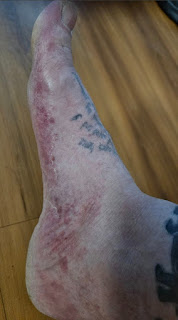
That night in the hotel room I remove my boots to assess the damage. 36 hours of wet feet and hot, sweaty conditions has led to Trench Foot. If I can't sort this out I'm afraid I won't make the next 9 days.
Part Six - IBR 2023
Reality Setting In
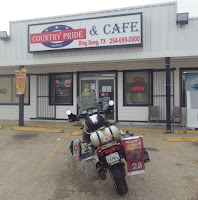 The alarm goes off far too early and I'm donning still wet gear. This doesn't bode well for my feet, but there's little I can do at this point. Stepping outside at 4am I'm hit with a wall of hot, humid air. My glasses instantly fog up, as does my visor even with pinlocks.





